


The 2025/26 Championship numbers reveal a league that never stands still, where results swing on margins and fortune, and where data tells a story that points alone cannot.
The latest expected points model from Opta shows how the Championship’s table rarely reflects its true balance. For Wrexham supporters watching from the outside, it is a reminder of what lies ahead. The Championship rewards control and identity more than luck, and that is exactly what Wrexham’s rise underlines. The club has built a structure that values performance over streaks. In a league driven by chaos, that approach may prove its greatest strength and one that means the Racecourse remains full for every fixture.
The data behind the chaos
The expected points model runs each match through 10,000 simulations based on expected goals values. It strips out luck and focuses on how teams perform over time. The results highlight how uneven the Championship can be.
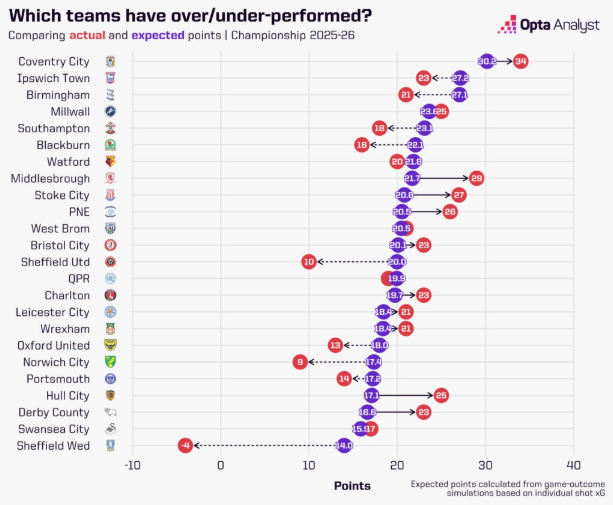
Coventry lead both tables, real and expected, with 34 points from 15 games and 30.2 expected points. That consistency marks them as the most reliable side in the division. Others have found success harder to justify. Middlesbrough, Stoke and Hull have all overachieved their expected points totals by between six and eight. Their results reflect streaks of finishing form and favourable margins, not lasting dominance.
At the other end, Sheffield United’s struggles show how variance can punish a team. They have just ten points when their performances merit closer to twenty. That kind of swing can shape a season and alter a club’s entire outlook.
The data confirm what most fans already sense. The Championship is a test of endurance more than flair. Success often comes down to repeatable habits rather than one-off moments.
Wrexham’s rise built on order, not luck
This is where Wrexham’s story fits the numbers. The club’s progress has not come from bursts of fortune but from a consistent football plan. The team’s structure and recruitment have followed a clear pattern since the start of the climb. That same discipline defines the Championship’s most stable sides.
While other clubs rely on brief purple patches or overperformance, Wrexham have shown patience and cohesion. The club’s identity, shaped by steady improvement and internal clarity, is built for the unpredictable rhythm that defines the next level. Where volatility hurts others, Wrexham’s control can help them hold their line.

This opinion is not about predicting promotion or immediate success. It is about recognising the logic behind the club’s method. The expected points model proves that results often disguise the truth. Wrexham’s rise, by contrast, is built on aligning performance with outcome. That balance is what sustains progress.
The Championship may appear chaotic, but beneath it lies a simple rule: teams who understand their structure last the longest. The numbers prove it. Coventry’s steadiness leads; Sheffield United’s waste costs them ground. The same logic supports the belief that Wrexham’s rise is not temporary. It is built for the kind of league where order beats luck.